Why Drone Crop Treatment Is Changing How UK Farms Work
@sx1bfu2mvd
A fresh look at an old job
There is a moment in early spring when the grass starts growing faster than the livestock can eat it. For most farmers, that means a phone call to the contractor, a few days of waiting for the right weather, and then a tractor crawling across every field with a spreader. The job gets done, but it takes time, fuel, and a lot of patience. Over the past few seasons, I have watched a quieter option take hold on UK farmland: an agricultural drone moving low over the crop, doing the same work in a fraction of the time.
Drone crop treatment is not about replacing the tractor overnight. It is about using the right tool for the right pass. When the ground is too wet to travel, or the crop is too tall to drive through, a drone can still get on top of the work. That alone has saved more than a few difficult springs for growers I know.
What drone crop treatment actually involves
At its simplest, drone crop treatment means using an agricultural drone to apply something to a crop. That something could be a pesticide, a herbicide, a fungicide, or a dose of fertiliser. It can also mean seed drilling into a field that is too soft for a drill to cross without causing damage. The drone carries a tank or hopper, flies a planned route over the field, and releases the product at a set rate.
The machines doing this work are not hobby toys. The DJI Agras series, for example, is built for farm work, with tanks that hold ten litres or more and rotors designed to create a downward airflow that pushes the product into the canopy. That airflow matters. It means the spray reaches the lower leaves, not just the top surface, which is exactly what you need for certain fungicides and contact herbicides.
What makes drone crop treatment different from a conventional sprayer is the precision. A tractor sprayer covers a set width and applies the same rate across the whole field, even where the crop is thin or the pest pressure is low. A drone can change the rate on the fly, matching the application to what the crop actually needs. That is variable rate application in its truest form, and it is changing how growers think about crop protection.
Where drones earn their keep
The most obvious win is on awkward ground. I have seen fields with headlands so tight that a sprayer has to do a three-point turn every thirty metres, wasting time and leaving gaps. A drone does not care about headlands. It turns in the air and carries on, so the coverage is more even and the job is faster.
Then there are the crops that get too tall for ground equipment. Late-season top dressing on oilseed rape, for instance, is a classic problem. The crop is shoulder high, the ground is soft, and driving through it would flatten a swathe. A drone flies over the top and drops the fertiliser without touching a single plant. That is the kind of practical benefit that wins over sceptical farmers.
Drone spraying also shines on small fields and awkward shapes. UK farmland is full of odd corners, steep banks, and fields that are not quite big enough to justify a full-size sprayer. With a drone, those areas become manageable. You can treat a two-acre paddock or a ten-metre strip along a hedge without firing up a 200hp tractor.
The data side of the job
What I find most interesting is how drone crop treatment connects to the wider world of precision agriculture. The same drone that sprays can also scout. It can carry a multispectral camera and produce crop scouting images that show exactly where the crop is stressed, where the nitrogen is running low, and where the weeds are coming through.
That geospatial data becomes the map for the treatment. Instead of walking the field with a stick and guessing, you get a yield map from last season, a vegetation index from this week, and a clear picture of where the field boundaries actually lie. The drone then uses that information to apply the product only where it is needed. This is not science fiction. It is happening on farms across the country right now.
The practical effect is a reduction in wasted input. You are not putting pesticide on a patch of crop that is already dead. You are not spreading fertiliser on a headland that has more than enough. Every litre and every kilogram goes where it will do the most good, which saves money and reduces the environmental load.
Rules and realities
It would be easy to paint this as a frictionless upgrade, but that would be dishonest. There are rules, and they matter. In the UK, the Civil Aviation Authority sets the framework for all drone operations, and agricultural work sits firmly inside that. You need the right permissions, the right training, and the right insurance. This is not a job for someone who bought a drone on a whim.
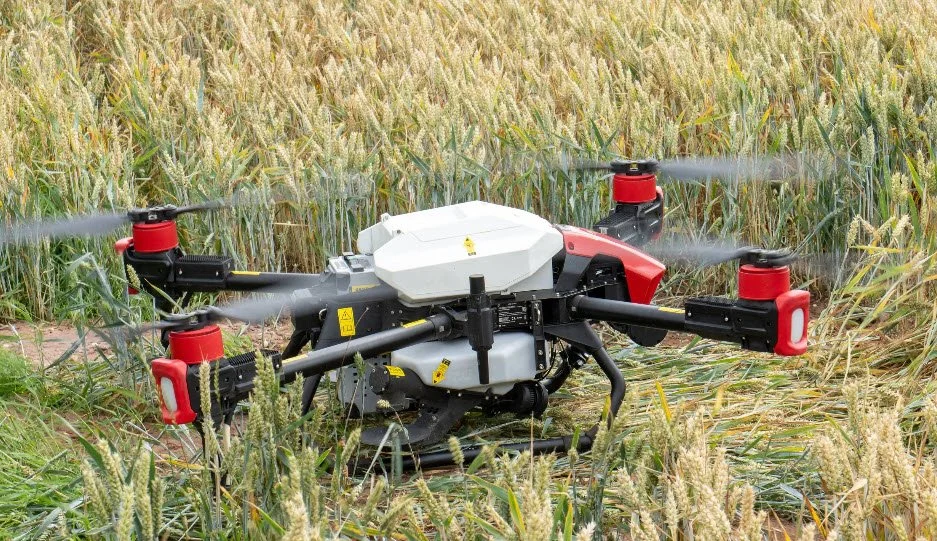
The weather is another reality. Drones are lighter than tractors, and they feel the wind more. A gusty day can ground a spray drone when a tractor would carry on. That means the window for drone crop treatment can be narrow, and you need to plan around it. The flip side is that when the weather is good, you can cover a surprising amount of ground in a single day.
There is also a question of economics. A drone is cheaper to buy and run than a full-size sprayer, but it carries less product. For a large arable farm with hundreds of hectares, a drone may never replace the main sprayer. It works best as a complement, doing the jobs that the big kit cannot do well. For a smaller farm, or a contractor serving small fields, it can be the primary tool.
Agronomy in the air
What makes drone crop treatment genuinely useful is the agronomy behind it. A drone is only as good as the plan it follows. Knowing what to apply, when to apply it, and at what rate still comes from the same knowledge that has always driven good farming. The drone just delivers that knowledge more accurately.
For example, a variable rate application of fungicide on wheat might be based on a disease risk map built from variety, weather data, and previous seasons. The drone reads that map and adjusts the flow rate as it crosses the field. The result is even protection across the crop, with no wasted chemical on areas that are not at risk.
That kind of targeted approach is easier to justify to a regulator or a neighbour than a blanket spray. It shows that you are doing what you can to minimise the impact while still protecting the crop. In a time when every input is under scrutiny, that is a real advantage.
What to watch next
The technology is moving quickly. Battery life is improving, tank sizes are creeping up, and the software that plans the flights is getting smarter. Some systems can already handle multiple batteries autonomously, swapping them out and carrying on without a human in the loop. That will push the daily coverage up even further.
I expect to see more integration with yield mapping and soil sampling. The drone that spreads your fertiliser in the spring can also tell you where the crop is underperforming in the summer. That feedback loop, from data to treatment to data again, is the real promise of precision agriculture. It turns a one-off job into a continuous conversation with the field.
For anyone considering drone crop treatment, the advice is simple. Start with a small area. Learn the rules, get the training, and work with someone who knows the local conditions. The technology is impressive, but it earns its keep only when it is used with care and judgment.
In the end, drone crop treatment is another tool in the shed. It will not suit every farm or every job. But for the right situation, it is fast, precise, and remarkably effective. And on a wet Tuesday in March, when the crop needs feeding and the ground is too soft to touch, that is exactly what you want.